
Finding Muscatine Residents by Record
Begin with what you already know. An address points to the Assessor, Beacon, or the MAGIC parcel system first. A full name fits Iowa Courts Online and the state voter lookup. It also fits the Recorder's grantor-grantee index. An older name belongs at Musser Public Library. Its city directories, newspapers, yearbooks, and cemetery material cover generations no database reaches. Each source answers a narrow question. Property rolls name a deed holder, not everyone under the roof. A voter result confirms one registration only when the form's identity fields match.
Treat the Muscatine residents directory as a sequence rather than one master list. Write down each spelling, date, address type, and source. Then compare the item against a second custodian's record. A public portal with no match is not the end of the road. Call the office. Visit its counter or terminal. Send the documented request form, or ask the library about print and microfilm holdings.
- Check the county property roll by owner name, address, or parcel number.
- Use Iowa's voter form when the name, house number, ZIP code, and birth date are known.
- Search Iowa Land Records for deeds, mortgages, liens, and name variants.
- Move an older question to Musser Public Library's directory shelf, newspaper run, and Genealogy Room.
- Ask the custodian for a counter search or Chapter 22 request when no public index covers the record.
Muscatine Residents Directory Offices
Muscatine holds the county seat. That puts the main land, court, voter, and parcel custodians within a short walk of each other. The Recorder ties names to recorded instruments. The Assessor connects deed holders to parcels, situs addresses, sales, and values, while the Auditor runs elections and voter-list requests and the Clerk of Court keeps case and probate files. These are separate indexes with separate rules. To walk a single road, turn to the Muscatine street directory once the right office is clear.
Muscatine County Recorder
414 E Third St, Suite 103
Muscatine, IA 52761
563-263-7741
Muscatine County Assessor
414 E Third St, Suite 202
Muscatine, IA 52761
563-263-7061
Muscatine County Auditor
414 E Third St, Suite 201
Muscatine, IA 52761
563-263-5821
Muscatine Parcel Clues Explained
The Assessor's help material splits its views by question. Owner names the recorded deed holder. Sales supplies transfer clues. Summary pulls together the assorted facts attached to a single parcel. The map can also display Parcels and Parcel Dimensions layers. MAGIC adds the PIN, house or address field, deed holder, contract holder, legal description, and map number. A mailing address may serve the tax recipient.
The MAGIC and Beacon access page is the county route to both tools. Search the situs address first. Save the PIN and legal description before chasing a name into deed records, because a parcel number still works when street text is blank or inconsistent.
- Parcel
- A mapped unit of land used for assessment and tax records.
- Situs address
- The physical parcel location, distinct from a tax mailing address.
- Index
- A finding aid that points to a record and may not include its full image.
- Roll
- An official list kept for a set purpose, such as assessment or voter registration.
The Muscatine County departments directory shows how the county separates these custodians.
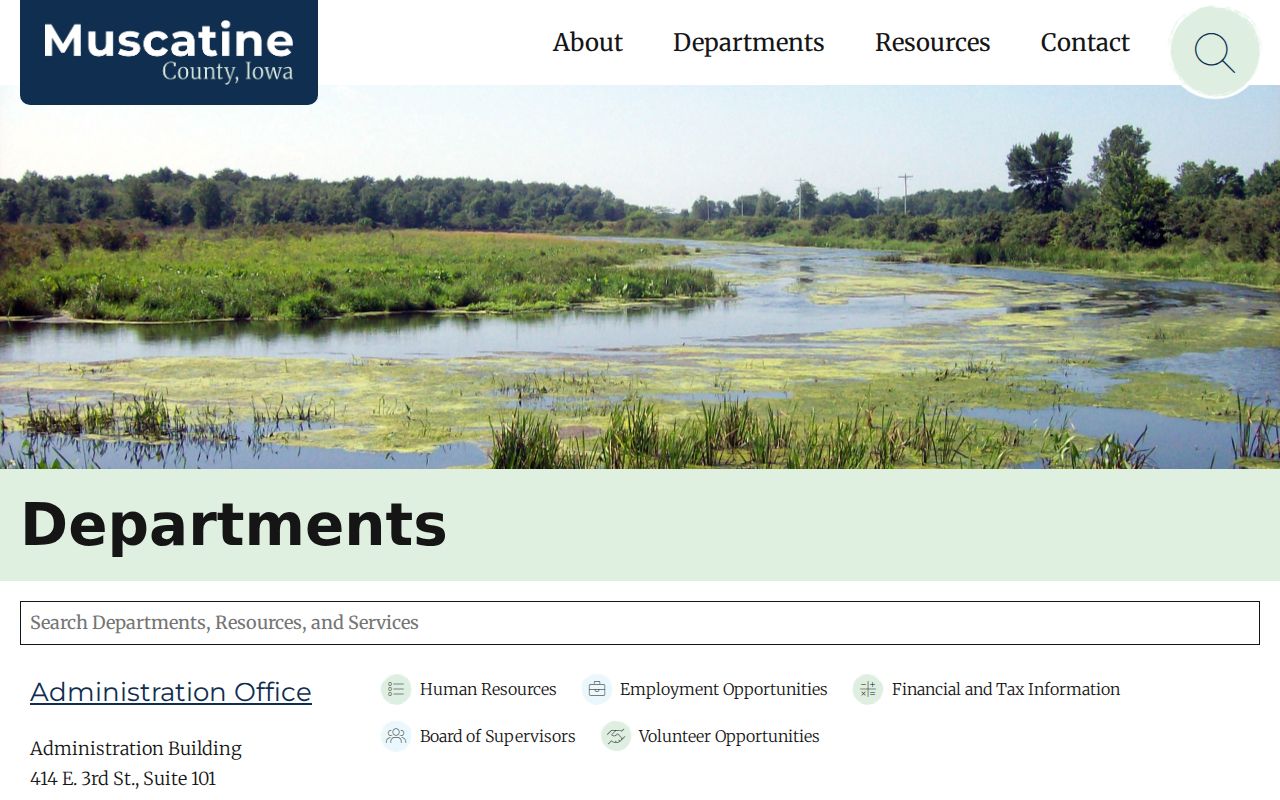
The department screen routes each request to the office that owns the record.
Muscatine Deed Names and Dates
Iowa Land Records offers Basic and Advanced search screens. For Muscatine County, the uploaded index starts January 1, 1989, and uploaded images start January 1, 2003. That split matters. A missing online image does not mean the deed never existed. Older material lives elsewhere. The State Historical Society of Iowa documents land and mortgage records back to 1838, and the Recorder's counter, county microfilm, and FamilySearch under its access terms can fill the gap.
The Basic screen requires at least one criterion. Select Muscatine County, then narrow by party, recorded date, or document type. A wildcard tames name variants. Matching parties can appear in more than one row, so compare the land-record number instead of counting each row as a separate instrument.
| Search control | How it narrows a Muscatine record |
|---|---|
| Grantor or grantee | Separates a person giving an interest from one receiving it. |
| Name or company | Accepts first and last name or a full entity name. |
| Recorded dates | Limits results by month, day, and year. |
| Document type | Filters deeds, mortgages, liens, plats, and easements. |
| Images only | Returns records with an uploaded image when selected. |
Current Muscatine Directory Sources
Current records exist for legal or civic reasons. None is a household roll. Match the source to the question. A parcel, a registration, a court matter, a recorded transfer, or a public appointment each has its own custodian. Check the source date and the address type before treating two names as the same person.
| Source | Who It Lists | Keeper | Access |
|---|---|---|---|
| Beacon and MAGIC | Deed holders and parcel contacts | County Assessor and GIS partners | Free web tools |
| Iowa voter lookup | One voter after an exact identity match | Iowa Secretary of State | Public form with five identity anchors |
| Iowa Land Records | Parties to deeds, mortgages, liens, and plats | County Recorder | Index online; images and older records vary |
| Iowa Courts Online | Named case parties and docket events | Iowa Judicial Branch | Web docket plus courthouse terminal |
| City boards and staff | Public appointees and city contacts | Muscatine City Clerk | City pages, minutes, or Chapter 22 request |
A name in one index is a lead, not proof of a current home. The Muscatine resident lookup gives the one-person sequence. The public voter form requires first name, last name, ZIP code, house number, and full birth date. It allows no broad name-only browse.
Muscatine Court Results Need Context
Iowa Courts Online searches party and docket data statewide. General public docket coverage starts after 1998. Search with a name and date of birth, or a case ID when known. Results can show the case number and type, party role, filing events, charges, disposition, and financial data. Bracketed links mark public detail. The web result is not the whole file.
The Muscatine County Clerk of Court keeps a public terminal at 401 E Third Street. The office can supply file access or copies under court rules. Terminal and paid access may expose extra fields. Juvenile, sealed, and other restricted material stays closed. With a common name, weigh birth date, middle initial, party role, filing county, and disposition before linking a result to a resident.
Portal limit. A docket entry proves that an event was indexed, but it does not state every fact contained in the court file.
The Muscatine Clerk of Court page lists the local file custodian.
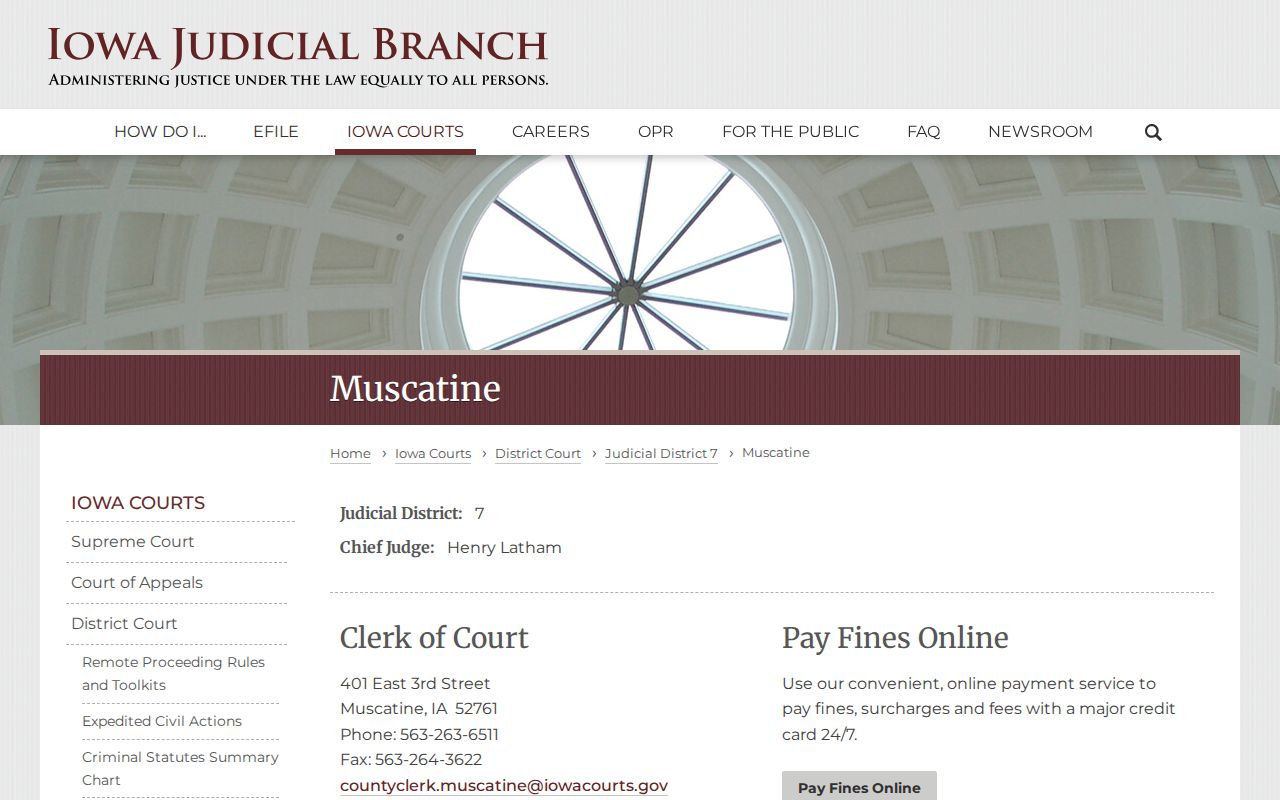
Older or missing docket gaps belong to Muscatine's local court route.
Muscatine Vital Records Have Gaps
The Recorder in Muscatine County issues certified birth, death, and marriage records. These fall under Iowa eligibility rules. County custody covers births and deaths from 1880 through 1920. It also covers 1942 to the present. The state route owns 1921 through 1941. Each certified copy costs $20. An application, identification, and proof of entitlement come with the order. A historical index works differently. It can supply a name, date, or place. It never serves as legal proof of the event.
The Iowa HHS vital records office handles the statewide path. For genealogical dates when certificate access is restricted, other sources can fill the gaps. These include SHSI, FamilySearch, Musser's in-progress local vital index, newspapers, cemetery print files, probate, and church material. Confirm the Recorder's mailing ZIP before sending anything. One county death page displayed an apparent 50208 typo while the official office address sits in Muscatine 52761.
On the state page, certificate ordering sits apart from archival research. An index hit therefore never becomes an unrestricted certificate.
Muscatine Chapter 22 Fallbacks
Iowa's Chapter 22 opens the records. Muscatine's City Clerk routes general city requests, while Police, Fire, and Public Works each hold their own files. The city accepts routine verbal requests. Its written form asks for a record description and offers requester contact fields for response or clarification. Policy targets a response within 14 working days when exemptions and complexity do not require more time.
Small jobs carry a posted fee schedule. For no more than 25 pages or 30 minutes of work, black-and-white copies run 25 cents per page, color runs $1 per page, and a CD costs $10. Larger work can include staff time and direct costs. An estimate above $10 requires consent. Work above $50 requires prepayment. Describe the record, department, date span, and address. An office will not create a new analysis from data it keeps in another form, whatever name you supply.
The Muscatine County Recorder page shows county access for land and vital material.
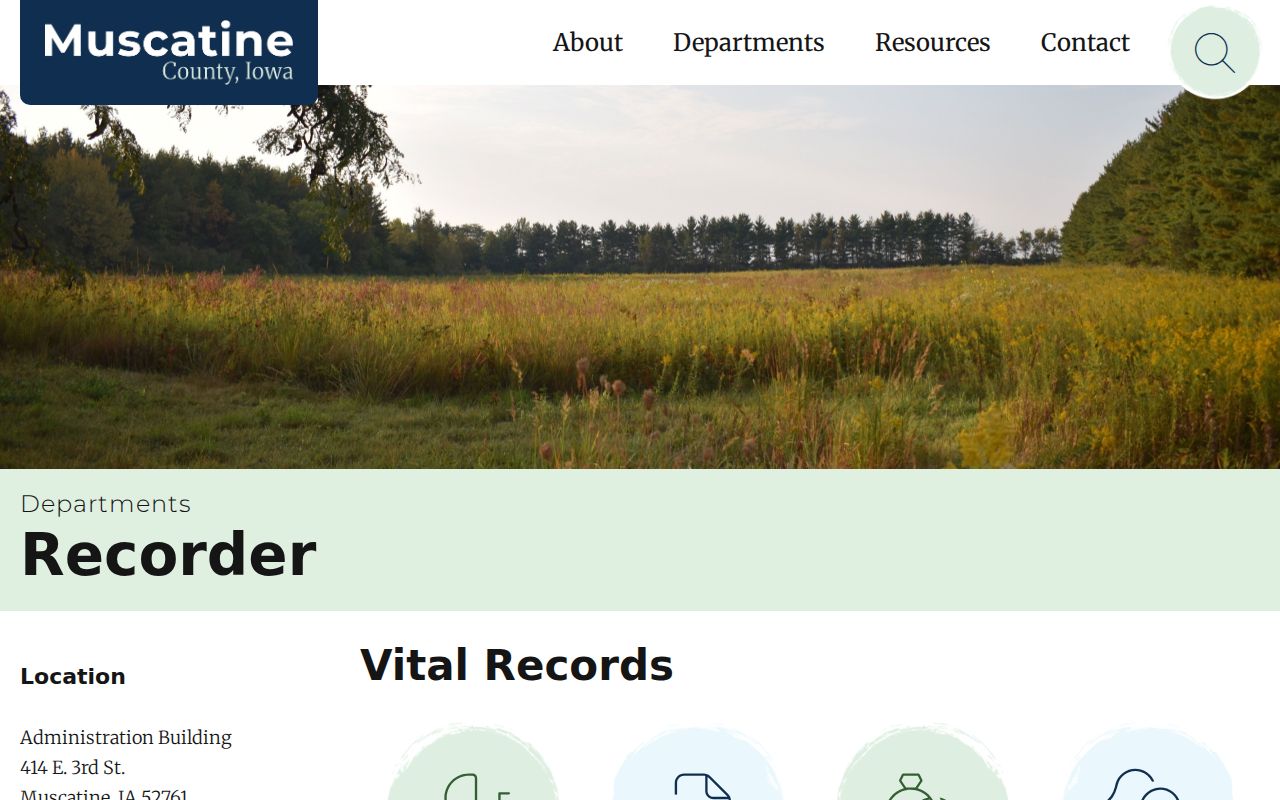
The Recorder screen keeps index search and copy orders separate.
Muscatine Official and Commercial Sources
Official sources stay narrow. Each field still has a known custodian and purpose. Commercial people-finder products blend data from many places, lag behind moves and deaths, and can merge strangers with similar names, so treat them as unverified leads. Answer the real question with a free official index before paying for any broad compilation.
| Source type | Strong point | Main limit |
|---|---|---|
| County or state index | Named keeper, defined record, and correction route | Only covers its legal record set |
| Library or archive | Historical dates, print context, and staff help | May require a visit, appointment, or microfilm |
| Commercial compilation | Can suggest alternate spellings or places | May be stale, merged, or hard to trace |
Lawful use. Use resident records for lawful personal research. Never use a name, address, or family link to stalk, harass, threaten, or harm anyone.
Historical Muscatine Directory Shelf
Musser Public Library lists selected Muscatine city directories from 1856 through 1959. The earliest volume is Mahlin's 1856 directory. Later publishers include Williams, Root, Holland, VanPatten, and Owen. Root's 1866 key leans on short terms for boarding, residence, intersections, compass sides, and the first or second door from a cross street. Read that key before turning an entry into a modern address.
The Genealogy Room holds far more than directories. It keeps newspapers, cemetery records, county histories, plat and Sanborn maps, yearbooks, and digital image collections. The Muscatine city directory collections get their own page.
Musser Public Library's local-history page lays out the collection routes. Call or email before travel. The library announced funding-related access changes in May 2026, plus a repair closure for August 24 through 26, 2026.
Muscatine Voter Lookup Fields
Iowa's Secretary of State registration form is built to confirm one voter. It will not reveal every name on a road or in a ZIP code. It asks for first name, last name, ZIP code, house number, and full date of birth. All five facts anchor the search. That works when the person is already known. A surname alone goes nowhere. The five-field design also keeps two Muscatine residents who share a name from being read as one.
Muscatine County's Auditor keeps local election administration. It publishes precinct maps and registration totals, and the March 2026 county count stood at 26,775 registrations: 10,506 No Party, 9,144 Republican, 6,847 Democratic, and 278 Other. Those totals describe the county electorate, not the city. A permitted voter-file request is a separate route under Iowa Code sections 48A.38 and 48A.39. Protected Safe at Home voters stay protected either way.
When the form fails, recheck spelling, house number, postal ZIP, and birth date. Ask whether the address sits inside Muscatine city or only carries a Muscatine postal name. Then call the county Elections office. Many guesses against a protected form achieve nothing.
Muscatine City Names by Purpose
The City Clerk holds the civic core of the Muscatine residents directory. That covers council minutes, claims, ordinances, codes, licenses, permits, and advisory-board appointments. Appointments can carry a name and term dates. The staff directory searches by category, first name, and last name. Treat both as civic lists. They name offices and roles, not proof of residency inside city limits. Use them to find a custodian or a public role before filing a request.
SmartGov pushes an address toward property records instead. Its public application search takes an application number, address, or name. It also accepts a ZIP, parcel, status, or date range. Results can show permit status, submitted and issued dates, inspections, and public documents. That documents recorded work at a parcel and may name a public applicant or contact. Occupants are not listed. Police Records offers another thread. It provides public incident, call-for-service, and accident reports, redacted as the record requires.
Greenwood Cemetery opens a municipal genealogy route. The office answers burial-location and history questions. Muscatine County publishes a cemetery-level list with towns and map coordinates. Greenwood itself offers no individual search screen. Call the cemetery rather than trust an unsourced memorial. The tradition runs deep here. Burials reach to 1843. The city describes 80 acres, a National Register chapel, and a 104-niche columbarium.
Muscatine Records Survived the Fire
A courthouse fire sits inside Muscatine's records story. Even official sources disagree on the date. County history gives December 23, 1864. The National Register nomination gives December 17. Cite both. Equally important, do not assume every early record burned. SHSI describes a Muscatine marriage index from 1837, deeds and mortgages from 1838, probate series, court material, and other county records. Those records survived or later reached archival custody.
The right fallback depends on the era. Modern deed index uploads begin in 1989, and images in 2003. Earlier land work moves to the Recorder, SHSI microfilm, and FamilySearch conditions. Printed residents directory research belongs at Musser. Probate can move from an estate number or card index to Clerk files. SHSI rolls are another stop. Newspapers often tie a decedent, heir, executor, address, or civic role to the formal record.
This layered history is why a Muscatine lookup keeps changing formats. One clue may start on a live parcel map. It can pass through a scanned deed and end on microfilm or a printed page. Keep a citation at each step. Never project a late-index fact into an early year without a dated record.