
Muscatine City Directory Shelf
Muscatine's directory record begins with named nineteenth-century publishers and continues through selected mid-twentieth-century volumes. “Selected” is important. The library's broad span does not promise a book for each year, and catalog or microform evidence may describe a holding that is not freely scanned online.
| Collection | Years | Where held | Access |
|---|---|---|---|
| Mahlin, City Directory and Advertiser | 1856 | Open Library catalog; library and special-collection references | Catalog record; ask the holding library for the volume |
| Williams, City Guide and Business Mirror | 1859–60 | Digitized catalog/PDF references and library collection | Online catalog or library copy |
| O.E. Root directory | 1866 | Internet Archive, Open Library, Musser | Free scanned pages and OCR; local copy |
| Holland, VanPatten, and Owen runs | 1869–70, 1877–79, 1883–86 | Musser and special collections; NPS bibliography | Check exact local volume before visiting |
| Musser selected directories | 1856–1959 | Musser Public Library Genealogy Room | Onsite shelf or research assistance |
| Gale city-directory microform | 1856–1959 in listed runs | Author index and research collections | Fiche or reels with documented missing years |
The Gale index lists long gaps, including 1910–22 and several scattered years in later reels. Missing paper or fiche can explain a blank result. It does not prove that a family left Muscatine. Confirm the exact shelf year with Musser staff before planning a visit.
Muscatine Directory Publishers Change
The earliest identified book is John Mahlin's 80-page 1856 Muscatine City Directory and Advertiser. Williams followed in 1859–60, O.E. Root in 1866, A.H. Holland in 1869–70, VanPatten in 1877–78, Owen with a county gazetteer in 1879, and Holland again for 1883–86. Each title reflects a different editorial plan.
| 1856 | Mahlin volume combines history, associations and officers, heads of families, and adult men. |
|---|---|
| 1859–60 | Williams volume is described as a city guide and business mirror. |
| 1866 | Root entries show occupations, business links, street placement, and residences. |
| 1877–86 | VanPatten, Owen, and Holland volumes extend the late-century resident and business trail. |
| Through 1959 | Musser identifies selected city directories, while the Gale index details microform runs and gaps. |
Do not merge the books as if their fields were uniform. A county gazetteer can reach beyond city blocks. An advertiser may name civic officers and firms. A later city directory may organize addresses in a form closer to a street index.
Decode a Muscatine Directory Entry
The Root 1866 scan gives a real abbreviation key and visible examples. “Apple John, grocer, Burlington Road ss 1 w Green” places a person and trade on the south side, one door west of Green. “res Cedar es 1 s Fourth” means a residence on Cedar's east side, one door south of Fourth.
| Name | The printed name and any business or family grouping captured by the publisher. |
|---|---|
| Trade or firm | An occupation or business tie where stated, such as grocer, carpenter, or a named firm. |
| Business placement | A shop, office, road, corner, or directional street-side location. |
| Residence placement | “res same” or a second street description; not a move-in date. |
| Source marker | Historical descriptors must be preserved as quoted source text, not expanded into an unsupported claim. |
| Missing fields | The sample has no standard spouse or owner/renter flag, and the absence proves neither status. |
- Criss-cross method
- Start with a street placement, recover the name, then turn to the alphabetical entry and other records.
- Householder index
- An address-oriented list of household names. No complete, separately labeled Muscatine run was verified.
- Abbreviation key
- The publisher's legend for short forms such as bds, bet, cor, res, ss, and ws.
OCR can confuse letters, punctuation, and old type. Check the page image whenever a name or street looks odd.
Musser's Muscatine Directory Room
The Musser Genealogy Room is at 408 E 2nd St and pairs city directories with cemetery books, county histories, plat maps, yearbooks, local newspapers, Sanborn maps, probate help, and building surveys. Listed help times are Tuesday 3–5, Wednesday 6–8, and Thursday 12–2, with appointments through the library reference email.
General posted hours are Monday through Thursday 10–8, Friday 10–6, and Saturday 10–2. Check before travel. A May 2026 funding notice described reduced hours and the loss of HeritageQuest and other digital resources, and the page showed a repair closure for August 24–26, 2026.
The Genealogy Room page was captured successfully and shows the current research access point.

Ask staff for the exact directory year, format, and database access before relying on an older catalog description.
Reverse a Muscatine City Directory
No official source identified a complete, separately labeled Muscatine reverse telephone-directory run. The practical reverse method still works. Search OCR or a staff-assisted volume for the street, direction, intersection, and door count, recover a name, then use the alphabetical section.
Follow the name into a later directory, obituary index, newspaper, probate file, cemetery record, or deed. Old house numbering may not match today's parcel. Use a Sanborn sheet, plat, legal description, and cross streets to keep the location stable while its label changes.
Note: A city directory is a dated publisher snapshot, not a complete census or proof that every named person stayed all year.
Beyond Muscatine City Directories
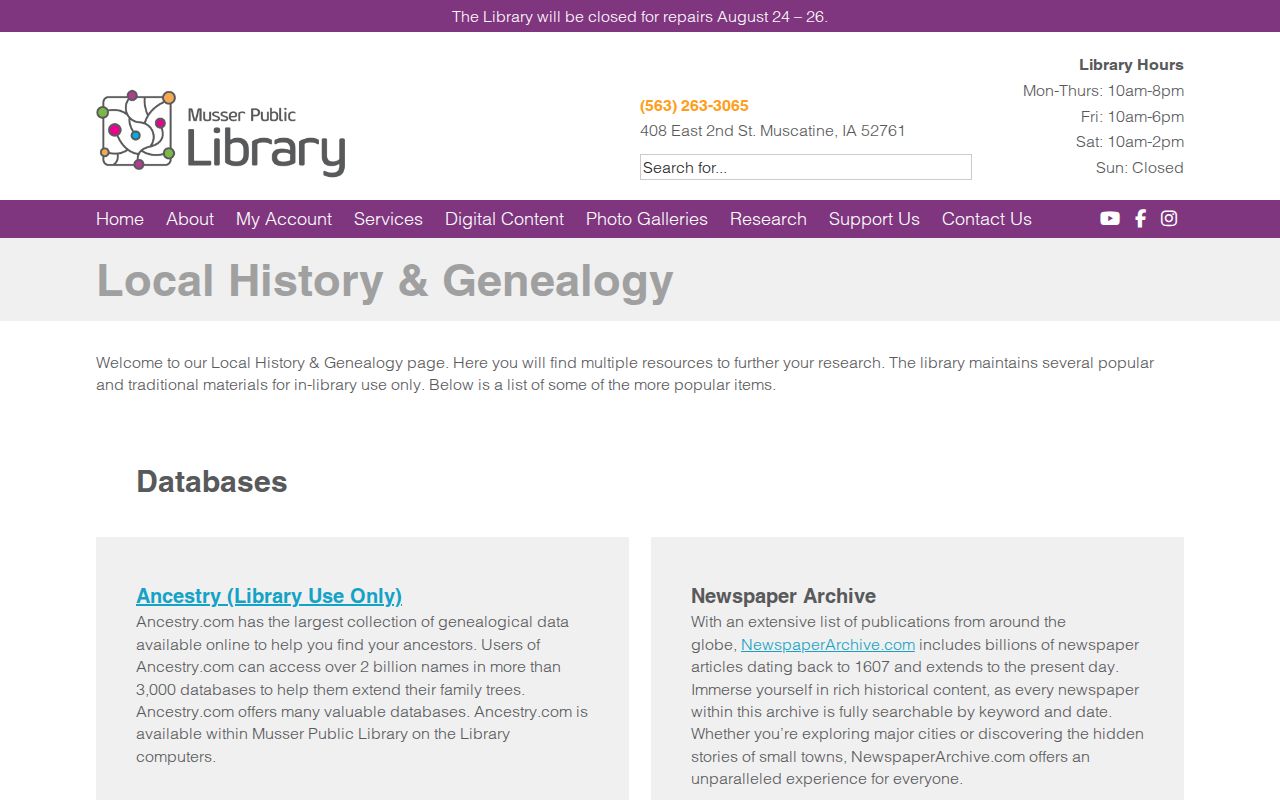
The Musser local-history collection supplies the sources that test a directory match. The Muscatine Journal archive runs from 1873 through April 2019. Sanborn map years include 1883, 1888, 1892, 1899, 1905, 1912, 1919, 1928, and 1946. The local birth, marriage, and death index is useful but incomplete and still in progress.
Yearbooks can reconnect a classmate name with a school year. The Nichols archive reaches the last senior class of 1961 and describes 493 alumni. The Oscar Grossheim collection preserves more than 50,000 glass-plate negatives from the late 1890s through the early 1940s, with more than 3,000 digitized. A photo caption, newspaper notice, and directory address can corroborate one another.
The local-history holdings page shows the range of Muscatine material that surrounds the directory shelf.
Use each companion by date. A later obituary may resolve why a name disappears, while a map explains the address itself.
Muscatine Records Beyond the Shelf
The State Historical Society's Muscatine holdings reach beyond printed directories. Listed county groups include marriage indexes from 1837, deed and mortgage records from 1838, probate groups from 1838–39, naturalization series, town lots, cemetery material, and court records. The exact run depends on the record group.
Probate material also has a Musser card index and microfilm route, with post-1968 paper held by the Clerk. FamilySearch adds county birth, marriage, death, and naturalization collections. A catalog or index is a finding aid, not always the source image or a certified record.
The successful SHSI holdings capture displays the state archive route for Muscatine County materials.
Move from the directory citation to the named archive series, then request the exact volume, roll, or file.
Muscatine's Courthouse Fire Record
Two official histories give different December 1864 fire dates. The county history says December 23, while the National Register nomination says December 17. Many early record series still survive at SHSI, and no official inventory states that every pre-fire record was destroyed.
That conflict is a research lesson. Cite the date to its source, then search the surviving group instead of repeating a total-loss myth. A directory, land book, probate index, later microfilm, and state archive description may preserve different parts of the same person's trail.
Trace Family in Muscatine Directories
Begin with the closest known name and year. Copy the city directory title, page, spelling, trade, business address, and residence text. Then build a dated chain rather than a list of names that merely look alike.
- Find the name in the alphabetical pages and inspect the original page image or book.
- Read the abbreviation key, then copy the street side, corner, door count, shop, and residence exactly.
- Check the next available directory both forward and backward. Record a move, changed spelling, new trade, or missing year without guessing why.
- Pair the directory with the nearest released federal census, using schedules through 1950 where the dates fit.
- Test the match with newspapers, probate, cemetery records, vital indexes, naturalization, deeds, yearbooks, or photographs.
A disappearance may mean death, departure, omission, a name change, or a missing volume. The Journal's obituary and estate notices can help, as can Greenwood Cemetery and probate. For modern address-keyed records, shift to the Muscatine street directory workflow rather than stretching a historical volume beyond its date.